Inside the Turbulent Making of “The Wild Geese”
Filmmakers sometimes chase projects with an almost stubborn devotion, and that persistence shapes everything that happens on and off the set. The story behind “The Wild Geese” is one of those rare cases where the events surrounding the production feel just as charged as the film itself.
What began as a bold plan from British producer Euan Lloyd grew into a complicated, booze-riddled, star-heavy mission set against political tension, searing heat, and a cast wrestling with personal demons.
Lloyd spent years searching for the right story, and the path that brought him to Daniel Carney’s unpublished novel changed the course of his career. What followed was a rugged mix of ambition, chaos, and unforgettable talent—both in front of and behind the camera.
How the Idea Took Flight
Euan Lloyd carried the desire to make an ensemble action film ever since working on publicity for “The Guns of Navarone.” According to Tony Earnshaw, author of Fifty Men in the Valley of the Shadow, Lloyd often described his ideal project as an “all-star rollicking, roistering, rollercoaster action movie.”
When Lloyd reached Carney’s manuscript—originally titled The Thin White Line—he found exactly what he had been waiting for. The story followed a team of mercenaries sent to rescue a deposed African leader, only to be double-crossed and left stranded. Carney, born in Rhodesia, had pulled from real political turmoil in the post-colonial Congo, including the 1967 hijacking and capture of Moïse Tshombe.
Lloyd helped Carney secure publication rights, then used foreign sales to assemble a budget estimated at £12 million—an impressive figure for the era. Andrew McLaglen took the director’s chair, Reginald Rose wrote the screenplay, and Lloyd chose the title “The Wild Geese,” inspired by Irish mercenaries of the 17th and 18th centuries.
A Cast Packed With Legends—and Luggage

Instagram | thewildgeeseawakening | Burton, Harris, and Moore made The Wild Geese an all-star epic.
Bringing together Richard Burton, Richard Harris, and Roger Moore made the film feel larger than life. Yet the dynamic was more complicated than the polished image on posters.
Burton’s agent reached out directly, telling Lloyd that Burton needed to make this film. The actor’s career had slipped into decline after a string of commercial disappointments and his public battle with alcoholism. He had recently remarried and was working to rebuild his life and image. “His agent said, ‘Mr Burton has to make this film,’” Earnshaw recalls.
Casting Harris carried even more risk. His behavior on “Golden Rendezvous” left him nearly unemployable. To ease studio fears, Harris agreed to place half his salary in escrow—he would lose it if he drank or caused problems. Lloyd believed in Harris strongly enough to escrow his own salary as well. Each day, Harris checked in with director McLaglen, who signed a slip confirming he stayed sober.
Moore was the safest choice. Riding high from his successes as James Bond, he arrived between “The Spy Who Loved Me” and “Moonraker,” blending charm with a surprisingly sharp edge. In the opening scene, his character Lt. Shawn Fynn force-feeds strychnine-laced heroin to a mobster—far from Moore’s lighter Bond persona.
The supporting cast included a mix of seasoned performers—Percy Herbert, Jack Watson, Ronald Fraser—and second-generation actors like Glyn Baker (son of Stanley Baker), David Ladd (son of Alan Ladd), and Anna Bergman (daughter of Ingmar Bergman). Their presence created built-in publicity for Lloyd.
Life on a Challenging Set
Production took place in Tshipise, South Africa, where cast and crew stayed in rondavel huts at a local spa resort. Temperatures climbed high enough to drain the energy from nearly everyone. Burton and Harris kept mostly separate from the group in larger homes up on a hill.
The set was hardly dry despite press claims. Baker recalled many beer-heavy nights around the camp, while Moore entertained with late backgammon games and an impressive ability to drink all night and walk on set the next morning ready to work. As producer Jonathan Sothcott put it, “Moore was a hard drinker too, but not a drunk.”
Harris slipped once, confessing to McLaglen the next morning, “Guv’nor, I was a bad boy last night,” and was given a pass for that single incident.
The star power didn’t end with the cast. High-profile mercenary “Mad Mike” Hoare—Second World War veteran, accountant, and later soldier of fortune—served as a technical advisor. Hoare had commanded 5 Commando in the Congo and became the inspiration for Burton’s Col. Faulkner. Baker described Hoare as looking more like a strict schoolmaster than a mercenary, yet his reputation was anything but mild.
Several veterans of Hoare’s unit assisted with training and weapon sourcing, including Ian Yule, who also appeared onscreen as Sgt. Tosh Donaldson. Known for his intensity, Yule often clashed with stunt performers—one punched him, while another left scorpions in his bed.
Racial Tension and Real Risks
The production’s decision to use an integrated cast brought both praise and hostility. South African actors Winston Ntshona and John Kani—already celebrated on stage—played key roles. Yet working in apartheid-era South Africa came with danger. Kani was cautioned not to walk at night due to threats from racist white locals.
Years later, Kani said the concern extended far beyond harassment: “There was a concern we could be killed.”
Writer Don Short, visiting the set to report on the film, was attacked by two white locals after a bar argument about apartheid. They beat him severely, dragged him into the bush, and urinated on him to attract animals. He eventually regained consciousness and found his way back.
The film portrays racial conflict through the tension between Hardy Krüger’s Lt. Pieter Coetzee and Ntshona’s President Limbani. Limbani’s hope for unity between white and Black citizens gradually softens Coetzee’s prejudice. Krüger later criticized the final cut for trimming their emotional moments in favor of action.
Explosive Action—and Real Danger
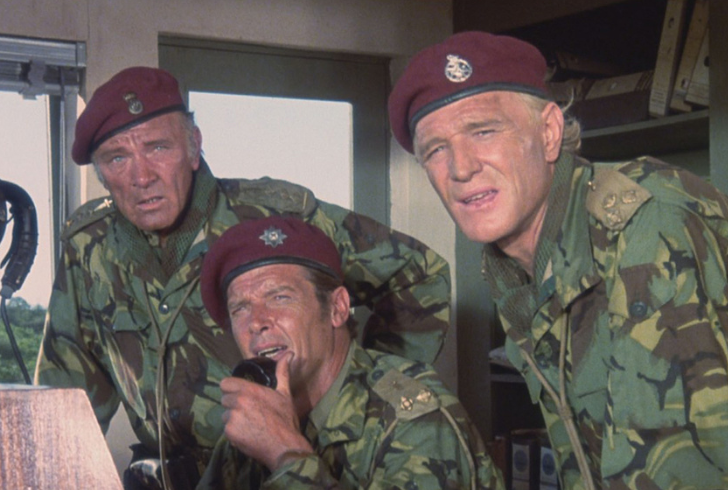
Instagram | thewildgeeseawakening | “The Wild Geese” was an action-packed film full of intense, dangerous combat.
The film delivered on its promise of relentless combat: crossbow kills, flaming bodies, ambushes, and sweeping firefights. Burton cracked at one point, “This is getting dangerous. We’re actors, for crying out loud.”
The climactic escape scene almost turned deadly. As the cast sprinted toward a moving Dakota aircraft, one actor tripped near the spinning tail. Harris tackled him out of harm’s way, likely saving his life.
Reception and Long-Standing Legacy
“The Wild Geese” drew strong audiences in the UK but struggled in the US. Some critics targeted its depiction of African politics and questioned why respected Black actors participated. Ntshona and Kani responded directly, describing the integrated cast as a meaningful advancement for Black performers in South African cinema.
Jonathan Sothcott later said the film irritated what he called the “nose-pinching, middle-class Bafta mob,” adding that its unapologetic action and gritty tone were part of its enduring appeal.
Today, with the restored edition returning to cinemas and arriving on 4K Blu-ray, “The Wild Geese” sits firmly in the realm of rugged, Sunday-afternoon adventure films—filled with high stakes, big personalities, and a level of intensity that rarely appears in modern action movies. Earnshaw sums it up succinctly: “It’s not high art, it’s high adventure.”
“The Wild Geese” remains one of those productions where the chaos surrounding the film becomes inseparable from what appears on screen. The personalities, the political atmosphere, the scorching heat, and the hard living all left lasting marks on the final work. Nearly five decades later, the film still attracts attention thanks to its cast, its bold approach, and the unconventional, volatile path that brought it to life.